FFMPEG has multiple supported deinterlacing filters. Here they are: 10.14 bwdif Deinterlace the input video ("bwdif" stands for "Bob Weaver Deinterlacing Filter"). Motion adaptive deinterlacing based on yadif with the use of w3fdif and cubic interpolation algorithms. It accepts the following parameters: mode The interlacing mode to adopt. It accepts one of the following values: 0, send_frame Output one frame for each frame. 1, send_field Output one frame for each field. The default value is send_field. parity The picture field parity assumed for the input interlaced video. It accepts one of the following values: 0, tff Assume the top field is first. 1, bff Assume the bottom field is first. -1, auto Enable automatic detection of field parity. The default value is auto. If the interlacing is unknown or the decoder does not export this information, top field first will be assumed. deint Specify which frames to deinterlace. Accept ...
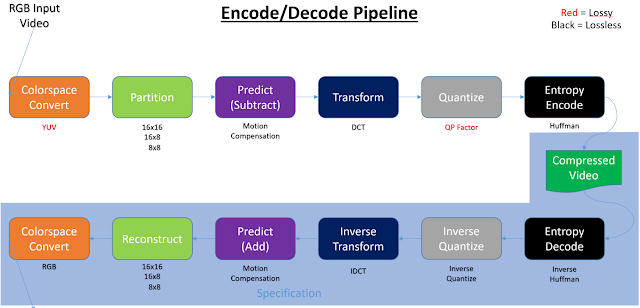
Introduction Video decoding/encoding can take place in the following four types of silicon: 1. General purpose CPU silicon (x86, ARM, SSE, AVX, …) 2. Dedicated CPU silicon (Intel QuickSync, AMD VideoCoreNext) 3. General purpose GPU silicon (cores) (GPGPU, Cuda, OpenCL, Shaders, …) 4. Dedicated GPU silicon (NVidia PureVideo (decode), NVida NVENC (encode)) (Table 1) When video is encoded or decoded any combination of the above silicon can be used. Being this paper is focused on everyday PCs, I’ve left out things like FPGAs, but you could consider an FPGA solution to be more like a general purpose GPU silicon solution. Note, at times this paper uses the term SIP (Semiconductor Intellectual Property core) to denote dedicated encode/decode silicon. Encoding and decoding of video has a defined pipeline: When encoding or decoding video, any one of those colored blocks can be done in hardware or software. Sometimes a full software approach is ...
Overview Below you will find differing approaches to demuxing CC data from an MXF source. The CC data is in an ancillary meta data stream in the MXF. The format of the CC data is vbi_vanc_smpte_436M. I have put together a list of working solutions based on off-the-shelf software which, except for one case, we would have to purchase. The first set of software can take an mxf file and parse out the CC data and convert that CC data to something like SAMI or SCC. Complete Solutions Telestream: $12,000 Enterprise Edition - www.telestream.net - http://www.telestream.net/pdfs/user-guides/CaptionMaker-UserGuide-6.4.pdf - Caption Maker - GUI: Can import MXF, process the ancillary data to 608 subs, and export to sami. - Caption Maker - Command Line: CapMaker.exe /ImportType=72 /ImportFile=file.mxf /ExportType=04 /ExportOutFile="captions.scc" - I've finally been able to evaluate the CLI. It works fine. Just as fast as ccConvert. - In ...
Comments
Post a Comment